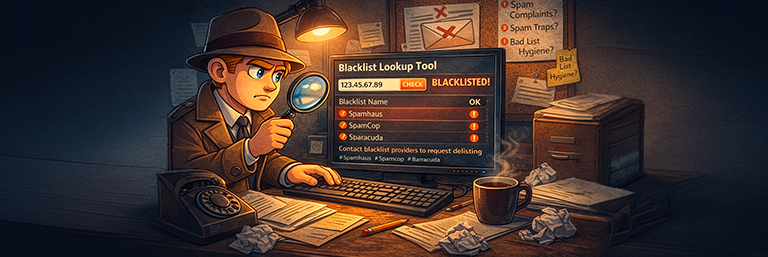
The question usually appears in the middle of an incident. A campaign slows down, Outlook starts bouncing one stream, sales notices replies missing, and someone drops a checker screenshot into chat. That is when am i on a blacklist stops sounding theoretical. But urgency does not make the question precise.
Used well, am i on a blacklist is an intake question. It helps you decide what is listed, which receivers care, and whether the listing explains the delivery damage you can actually measure. Used badly, it pushes the team toward delisting forms, infrastructure changes, or reputation panic before anyone has proved the listed asset is even the one causing the incident.
Table of Contents
When a blacklist scare is real and when it is noise
A blacklist scare becomes expensive when the evidence is still thin.
That is why the first useful answer to am i on a blacklist is rarely a simple yes or no. The broad question hides at least three separate concerns: what object is listed, whether the affected providers care about that list, and whether the listing explains the incident you are seeing right now. When those three points stay blurred together, teams freeze sends, blame the wrong asset, or chase removal before they understand the cause.
In practice, am i on a blacklist should trigger classification before action. If one mailbox provider is rejecting while the rest of your program behaves normally, the incident may be narrower than the question sounds. If delivery is softening without obvious hard blocks, the problem may sit in spam placement, complaint pressure, or weak domain trust rather than in a public listing. The broad question matters, but only as the start of disciplined triage.
The real job is to separate signal from theater. A screenshot can create urgency; only evidence can tell you whether the listing belongs at the center of the investigation.
What the result can prove and what it cannot
A blacklist result can narrow the field, but it cannot explain the whole sending system.
When a team asks am i on a blacklist, the lookup is really checking whether an IP, domain, or other sender-linked asset appears on one or more reputation lists. Some of those lists are operationally important. Others are informational, niche, or mostly useful for research. Spamhaus makes that distinction clearly in its material on how blocklists work. The result can tell you that an asset has attracted distrust. It cannot tell you, by itself, whether that distrust is active at the providers hurting you most.
The same limit shows up in provider guidance. Gmail’s sender guidelines and Microsoft’s documentation on authentication and trust both point to a broader model: providers combine reputation, authentication, complaints, cadence, and engagement. So even when the answer to am i on a blacklist is yes, you still need to prove how much that answer matters operationally. Without that context, am i on a blacklist sounds more definitive than it is.
Identify the listed asset before you do anything else
Misidentifying the listed asset is how broad investigations go sideways.
Start by naming the object precisely. Is the result tied to a dedicated IP, a shared ESP IP, the visible From domain, the return-path domain, or a tracking domain? Those are different incidents with different owners. A shared IP listing may require coordination with an ESP. A domain listing may point to repeated trust problems tied to visible sender identity. A redirect or tracking-domain issue may force you to look at link infrastructure before you touch authentication or routing.
This is also where broad background pieces like Email blacklist: how it works and how to avoid it are useful but incomplete. If you are actively asking am i on a blacklist, a glossary is not enough. You need the exact asset under suspicion so the investigation stops drifting.
Match the listing to the receivers that are actually reacting
A listing only matters when the receiving side behaves as if it matters.
That means checking SMTP responses, bounce logs, timing, and provider concentration. If Microsoft-hosted inboxes are returning policy or reputation language while other providers are mostly healthy, the blacklist evidence may carry real weight. If Gmail placement is soft but hard rejects are absent, the same listing may be secondary or irrelevant to the present incident. When teams ask am i on a blacklist without looking at the receiver side, they often confuse a reputation clue with a delivery diagnosis.
For broader trust problems, pieces like Why are my emails going to spam? and How to check and improve your sender reputation often explain more than the lookup itself. A list entry can be real and still fail to explain the damage pattern that matters commercially.
Build the case before you ask for delisting
Delisting works best as the last step in a short evidence package, not as the first reflex.
If you are already asking am i on a blacklist, the next move is to build a case you can defend internally and, if necessary, share with the list operator. That keeps the team from treating every bad result like a moral emergency or a form-submission race.
- Confirm the exact list name and the exact asset that appears on it.
- Collect bounce samples, SMTP responses, and affected mailbox-provider patterns.
- Review what changed recently in list source, routing, authentication, cadence, or volume.
- Measure complaint pressure, hard-bounce rates, risky segments, and likely spamtrap exposure.
- Document the remediation already applied before you ask for removal.
This is the point where am i on a blacklist becomes operationally useful. The question stops being a panicked headline and becomes a sequence of proofs. If the incident operator asks why delisting should work now, you should be able to show what changed and why a repeat is less likely. Our background on how the Spamhaus Project handles delisting is much more useful after that evidence exists than before it.
Delisting is procedural. It does not replace the work of narrowing the cause, cleaning the source of the problem, and restoring trust in the sending path.
The sending behaviors that usually make a listing plausible
Listings are usually the visible edge of weak operating discipline.
Purchased data, stale CRM segments, complaint spikes, trap exposure, abrupt volume changes, weak unsubscribe handling, and broken authentication are the usual pattern. That is why the question am i on a blacklist often points back to list acquisition and sender discipline long before it points to a clever technical mystery. The infrastructure is visible; the habits underneath it are usually the cause.
The commercial consequence is broader than one incident. Bad intake burns volume, inflates bounce noise, weakens placement, and keeps teams in recovery mode. That is why articles like Email Deliverability: what is it and how to improve it and Permission-based email marketing starts with trust matter in this context. They describe the behavior layer that makes the blacklist question keep returning.
Bad list intake becomes reputation debt. That is also where SafetyMails matters most: upstream, before the next broad am i on a blacklist incident ever has a chance to form.
When the problem needs to narrow to IP, not stay broad
The broad question is over once the evidence keeps pointing to one network identity.
If rejection messages keep naming a numeric IP, if one pool or stream is failing while the rest of the program stays stable, or if shared infrastructure is the main source of uncertainty, then am i on a blacklist is no longer the right level of abstraction. At that point, you need to narrow the investigation: which IP handled the traffic, whether that IP was shared, what lists mention it, and whether the providers rejecting you are reacting to IP reputation specifically.
That is exactly where IP blacklist check for email: how to read the results and isolate the real issue becomes the better next step. It is not a competing article. It is the narrower branch you take after the broad am i on a blacklist question has done its job and the evidence has already reduced the scope.
Broad first, narrow second. That sequencing prevents teams from turning one suspicious result into an infrastructure-only diagnosis too early.
Why a clean result still leaves a wider trust problem
A clean checker result is not the same thing as healthy inbox performance.
A sender can ask am i on a blacklist, get a clean answer, and still underperform because complaints are elevated, segments are stale, authentication is uneven, or mailbox providers distrust the program for reasons the lookup does not see. That is why a clean result narrows the investigation but does not close it. The absence of a public listing is not the presence of trust.
If the listing layer comes back clean while the business problem remains, move into deeper monitoring. Google Postmaster Tools, reputation review, and sender-behavior analysis are better guides than running the same lookup again. The durable answer to am i on a blacklist is not repeated reassurance. It is a sending program that generates fewer reasons for distrust in the first place. In other words, am i on a blacklist should stop being the recurring headline of the operation.
Conclusion
Treat “am i on a blacklist” like incident intake, not like incident resolution.
The question helps when it forces precision: what is listed, which receivers are reacting, and what behavior made the listing plausible. From there, you can decide whether the problem stays broad, narrows to IP, or turns out to be a wider sender-trust failure. That is how am i on a blacklist becomes useful: not as a dramatic verdict, but as the moment the investigation finally gets specific enough to work.
FAQ
Does one listing mean all my mail is blocked?
No. One listing does not automatically block every message everywhere. The real impact depends on what asset is listed, which providers consult that list, and whether your bounce evidence shows that the listing is actually involved in the incident.
Should I request delisting before I fix the cause?
No. If you request delisting before you correct the list source, complaint pressure, authentication problem, or sending behavior behind the listing, you increase the odds of repeating the same incident. Build evidence and remediation first.
How do I know whether the issue is IP-based or domain-based?
Look at what the rejection messages and the lookup actually reference. If the evidence keeps naming a numeric IP or one sending pool, narrow the investigation to IP. If the evidence points to the visible sender, return-path domain, or a broader reputation pattern, keep the analysis at the broader sender-trust level.
Can a clean blacklist result still leave email going to spam?
Yes. A clean result only tells you that a visible public listing is not the main problem you can see. Spam placement can still come from complaints, poor engagement, weak segmentation, or authentication and domain-trust failures.