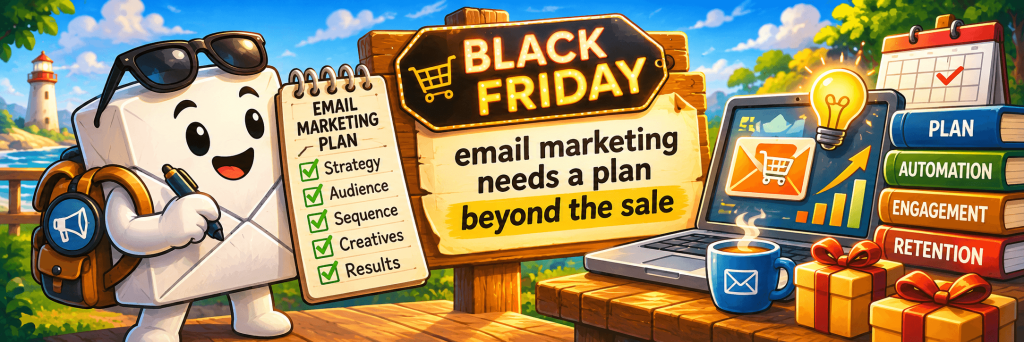
Black Friday email marketing needs a plan beyond the sale because a strong offer is only useful when the right people receive it in time and still welcome the next message. Prepare the audience before peak week, manage the live campaign by response rather than volume alone, and use the days after the sale to protect December.
A promotion has a closing time. The messages it leaves in people’s inboxes do not. Some customers will open an offer after it expires; others will receive another reminder after buying. The answer is not to make Black Friday smaller. It is to give Black Friday email marketing a plan for the audience, the live offer, and the days that follow.
Table of Contents
The sale has a second calendar
The checkout timer reaches zero on Friday. On Wednesday, someone opens the email for the first time. Its discount looks current, but the landing page says otherwise. The customer has not misunderstood the clock; they have encountered a message that outlived its promise. For Black Friday email marketing, that is why campaign completion cannot be defined only by the last scheduled send.
The delayed response is visible in data, too. In its analysis of 2025 sending patterns, Validity reported that volume during Black Friday week peaked at 75% above the year’s weekly average. Spam complaints rose 10% that week, but reached their high point seven to ten days later, when recipients encountered expired promotions. These are observations from Validity’s network, not a prediction that every 2026 sender will follow the same path.
That gives Black Friday email marketing two calendars. The first schedules the offer and its reminders. The second covers what customers will still see afterward, how they respond, and what the team should change before December’s next message. A good sale should finish cleanly, not merely stop sending.
Choose the audience before the campaign needs it
The largest available list is tempting when the year’s most visible offer is almost ready. Imagine adding a dormant segment on Thursday night because the creative team has finished and the revenue target is ambitious. Some addresses have gone stale; some people have forgotten the signup. The send gains nominal reach, but its first new signals may be bounces or complaints. That is an avoidable way to start Black Friday email marketing.
For Black Friday email marketing, audience readiness has four separate questions: Was the address collected with permission? Does this person expect a seasonal offer? Is the address still usable? Can the sender support this volume and cadence? A positive answer to one does not settle the others. The list is not a container to empty; it is a set of relationships and technical records with different histories.
The team can decide the order of contact before peak week: who should receive early access, who needs only the main announcement, and who should not receive a sudden reactivation attempt at all. Relevance is a sending decision made before the send. That is a more useful starting point than waiting for the first failure report.
Start with subscribers who still recognize you
An engaged customer who asked for offers and a lead who has been silent since a one-off download should not automatically receive the same urgent sequence. One may welcome a reminder; the other may barely recognize the sender. A useful Black Friday email marketing plan treats that difference as an audience decision. Use recent behavior, signup context, stated preferences, and purchase status to decide which message earns its place.
This does not mean sending less to everyone. In Black Friday email marketing, a relevant second email may help a customer make a decision. A repetitive reminder to someone who already bought does the opposite. The broader question of email frequency matters here, but the seasonal decision is more precise: who needs this message now?
Verify addresses without mistaking validity for permission
A mobile signup can contain a typo. An older address can disappear between campaigns. Neither becomes reachable because the offer is good. Validity found unknown-user rates, including hard bounces, running 50% to 60% above normal from mid-September to mid-November in its 2025 sample. That makes pre-send address review relevant to Black Friday email marketing; it does not justify blasting dormant segments merely to discover which contacts bounce.
SafetyMails’ email verifier helps teams identify invalid or risky addresses before a high-stakes send. Pair that with a sound list-cleaning process and a clear decision about which contacts should be mailed. Verification cannot establish consent, make an irrelevant offer welcome, or guarantee inbox placement. It makes the address layer more dependable; it does not replace the campaign plan.
An offer must still be useful when it arrives
Picture a flash offer that starts at 9 a.m. and ends at 1 p.m. The team schedules the email for the opening minute, but some messages are temporarily deferred and accepted later. Others are accepted quickly yet noticed at 3 p.m. In both cases, the campaign could look complete in a sending dashboard while the customer misses the moment that made the email valuable. That is the gap between scheduling Black Friday email marketing and delivering a useful offer.
Black Friday email marketing therefore has a timing problem that send-time optimization alone cannot solve. A receiving server may temporarily limit acceptance with a 4xx response, while an accepted message can still be routed somewhere other than the primary inbox. The latter distinction is documented in Twilio SendGrid’s delivery guidance. The example is hypothetical, not a measured claim that every late opening results from provider throttling.
The offer itself needs an end-of-life plan. Check that the email, its landing page, and any scheduled reminders agree about the deadline. If the email remains visible after the sale, the destination should say clearly what is available now. Do not make a customer discover the real terms only after clicking. A transparent closed-offer page can preserve more trust than a stale countdown.
Sent, accepted, and seen are different moments
A platform can report a successful send while the receiving server has not yet accepted the message. It can also report Delivered after a 250 OK response without knowing whether the recipient will find it in the primary inbox, another tab, spam, or not at all. Gmail’s Promotions tab is a normal inbox category, not the spam folder. The distinction keeps Black Friday email marketing from being judged on a single reassuring percentage.
Compare provider-level deferrals and bounces with clicks and purchases during the actual offer window. If one domain is slower or one segment is unresponsive, increasing the next full-list send is not a diagnosis. The difference between delivery and deliverability matters most when a deadline is real: technical acceptance is a necessary step, not proof that the offer was seen in time.
Let the live campaign answer back
A customer buys during the opening window, then receives two more countdown emails. Each automation may have been correctly scheduled in isolation. Together, they tell the buyer that the brand is not listening. Black Friday email marketing can stay energetic without becoming indifferent: purchase suppression and message priority belong in the live operating plan, not in a postmortem.
During the sale, read a small set of signals in context. A single blended metric can hide the segment that needs attention or the provider where acceptance is slowing. Black Friday email marketing needs a live decision loop, not just a fixed calendar. Use the pattern to choose an action while it still matters:
- Address failures: isolate the source or segment producing hard bounces before another send.
- Temporary deferrals: inspect the affected provider and timing instead of assuming the offer reached everyone on schedule.
- Complaints and purchases: find unwanted reminders, suppress recent buyers, and keep useful messages for people who still want them.
There is no universal number at which every Black Friday email marketing program should pause. The team needs its own baseline, a named decision-maker, and the ability to change one segment or message without switching off the whole campaign. A promotion can be responsive and still be commercially ambitious.
The first days of December complete the campaign
Cyber Monday closes, but the response to Black Friday may still be developing. Validity’s delayed complaint peak is a reason to keep the campaign report open for the following week. A separate Certified Senders Alliance analysis also observed post-Black-Friday pressure in its 2023 and 2024 Q4 data. These sources study different samples and years; their numbers should not be added into a universal penalty.
For Black Friday email marketing, the after-sale review is practical. Find scheduled offers that have expired, automations that still target recent buyers, and landing pages that no longer match the email. Then compare complaints, bounces, and engagement with the sender’s own pre-sale baseline. A December decline in one provider is more actionable when the affected audience and message are visible than when the team sees only an all-channel total.
Do not turn a higher complaint rate into a claim that the entire list is broken. Complaints can signal a mismatch in expectations, frequency, message relevance, or the offer’s lifetime. Likewise, a hard-bounce spike points toward address sources and suppression, not creative copy. Black Friday email marketing gives the team more evidence than a single sales day can show. Different signals deserve different repairs.
Decide what stops, what changes, and what continues
Suppose an old promotional email is still being opened on December 5. Its page says the deal is over, but the next scheduled reminder implies it is still live. Stop the reminder and correct the destination before making a new promise. Pausing every email would also silence order updates and useful follow-ups. The specific broken promise is what needs repair.
When Black Friday email marketing reaches this stage, the plan is not a ritual of retreat. Keep messages that remain relevant, change the ones whose audience or timing is wrong, and stop the ones that no longer tell the truth. That leaves room for a December campaign to begin on its own merits rather than inheriting an unresolved mistake.
Conclusion: keep the next conversation open
A strong Black Friday should produce sales and leave customers willing to hear from the brand again. The two outcomes support each other. Black Friday email marketing works best when the offer is timely, the audience is appropriate, and the team stays responsible for what people encounter after the deadline.
Verification can reduce avoidable address failures. Permission and segmentation help the message find the right people. Monitoring shows whether the campaign is still serving them, and post-sale care retires promises that have expired. Plan for the next conversation while this one is still underway. That is how Black Friday email marketing can make the sale count without treating December as an afterthought.
FAQ
Can email verification guarantee inbox placement for Black Friday?
No. Verification can identify invalid or risky addresses, but it cannot prove consent, make an irrelevant offer welcome, or guarantee where a provider places accepted mail. It is one part of a Black Friday email marketing plan, not a substitute for one.
Why might spam complaints rise after the sale ends?
Some recipients first notice promotional mail days later, when an offer may have expired. Scheduled reminders or unclear landing pages can add to the mismatch. Investigate the affected message and audience rather than assuming every late complaint has one cause.
What should a team check before its first December campaign?
Review expired offers and scheduled automations, suppress recent buyers from irrelevant reminders, and compare complaints, bounces, and engagement with the pre-sale baseline. Continue useful messages where the evidence supports them.