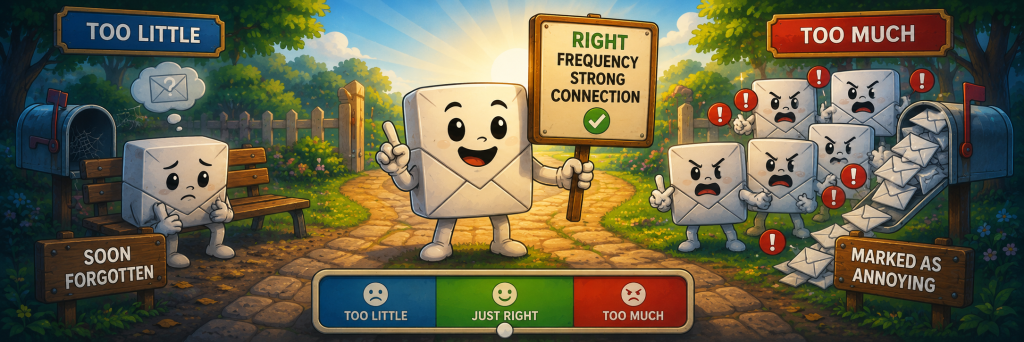
One more campaign can feel harmless inside a planning meeting. In the inbox, it can change the relationship. Email frequency decides whether a brand stays familiar enough to be remembered or present enough to be resented.
The right rhythm is not a universal weekly, biweekly, or monthly rule. It is the cadence subscribers can still connect to expectation, usefulness, and timing. Send too little and people forget why they subscribed. Send too much and attention turns defensive.
Table of Contents
When sending more starts to change what people feel
The same email can feel helpful on Tuesday and excessive by Friday.
Imagine a subscriber who gets a newsletter on Monday, a product promotion on Wednesday, a webinar reminder on Thursday, and an automated “last chance” email on Friday. Inside the company, each message belongs to a different program. Inside the inbox, it is one brand asking for attention again.
That is the hidden problem behind email frequency. Teams often measure volume by campaign. Recipients experience volume by relationship. When that relationship still feels useful, frequent contact can build familiarity. When it feels crowded, even strong content starts to lose the benefit of the doubt.
The goal is not to send as much as the list can tolerate. The goal is to send often enough that people remember why they wanted the relationship in the first place.
Email frequency is a signal, not just a schedule
Email frequency includes every recurring marketing touch a subscriber receives from the brand: newsletters, promotional emails, lifecycle messages, event reminders, product updates, re-engagement campaigns, and automations. A calendar may keep these streams organized for the team. It does not make them feel separate to the reader.
That means email frequency communicates intent. A steady newsletter can say, “We are here with something useful.” A sudden burst can say, “We need something from you.” The same number of sends can feel normal, excessive, or forgettable depending on expectation, relevance, and timing.
Spamhaus makes this connection explicit in its guidance on email frequency and engagement: setting expectations matters, meeting those expectations matters, and unengaged audiences need review rather than endless pressure. Cadence is not decoration around email deliverability. It is one of the ways senders prove they understand the audience.
Too little contact lets recognition decay
Silence can look respectful from the sender’s side, but too much silence creates a different failure. A person signs up after a webinar, hears nothing for three months, and then receives a sales campaign from a sender they barely recognize. The opt-in may be valid. The memory is not.
Recognition depends on recency. If subscribers forget the original context, later messages can feel random, even when they are technically legitimate. That is why email frequency supports permission based email marketing without replacing it. Consent starts the relationship. A recognizable rhythm helps preserve it.
Under-sending is not solved by sending filler. It is solved by purposeful contact: a welcome sequence, a useful newsletter rhythm, or a relevant follow-up that keeps the sender familiar without becoming intrusive.
Too much contact turns usefulness into pressure
More contact can work for a while because some subscribers are ready to buy, register, or act. The damage starts when the extra messages stop adding enough new value. At that point, email frequency shifts from presence to pressure.
Subscriber fatigue rarely begins with one bad email. It begins with repetition, overlapping automations, weak prioritization, and campaigns sent because the calendar had a slot. The signals appear as lower clicks, lower conversion per send, rising unsubscribe rate, and eventually spam complaints.
That pressure can affect sender reputation because mailbox providers learn from how people react to mail over time. A cadence problem can become a reputation problem. The inbox remembers behavior.
The right cadence starts with what people expected
The first useful limit on email frequency is not a benchmark. It is the promise the subscriber understood when they joined. A person who chooses a weekly newsletter expects a different rhythm from someone who asks only for product alerts or transactional updates.
Yahoo says senders should honor the frequency implied by the list’s intent in its sender best practices. That principle is simple, but it changes operations. Signup source, content category, declared preferences, purchase context, and lifecycle stage should shape how often someone hears from the brand.
An email preference center can make this explicit. Instead of guessing whether someone wants weekly updates, monthly summaries, product tips, or promotional messages, the team can let subscribers choose. Chosen cadence feels different from imposed cadence.
Expectation also makes testing cleaner. If the audience chose a weekly rhythm, a temporary increase should be treated as an exception with a reason, not a quiet new default.
Different subscribers deserve different rhythms
A single list-wide rule usually fails someone. It may neglect active subscribers who want more value, or it may pressure quiet contacts who already stopped responding. Equal cadence is not always fair cadence.
Email segmentation turns cadence into audience intelligence, not just content targeting. Engagement recency, click behavior, signup source, purchase history, customer status, and lifecycle stage should decide who can receive a steadier rhythm and who needs less contact.
Good email frequency is rarely identical email frequency. It is the same strategic discipline applied differently to different relationships.
Engaged contacts can carry a steadier cadence
Recent clicks, purchases, replies, trial activity, and event attendance all suggest that a subscriber still finds the relationship useful. Those contacts can often carry a steadier email cadence because the messages fit an active context.
But email engagement is not a blank check. A subscriber who clicks tutorials may not want daily discounts. A buyer who reads onboarding tips may not want every newsletter. Increase email frequency only when the additional send has a distinct purpose: a timely update, a useful lesson, a relevant offer, or a clear next step.
SafetyMails has a deeper guide to email engagement, and the same logic applies here: engagement is a signal to interpret, not a permission slip to fill the inbox.
Quiet contacts need less pressure
Inactive subscribers do not become safer because they stay silent. Silence can be tolerance, forgetfulness, disinterest, or a complaint waiting for the wrong campaign. Treating all quiet contacts like active readers makes email frequency harder to interpret and easier to resent.
Reduced frequency is not abandonment. It is restraint. A quiet subscriber may need fewer campaigns, a preference prompt, a focused re-engagement campaign, or a sunset rule if they never respond. Spamhaus also connects unengaged audiences, segmentation, and suppression in its guidance on email sunset policy.
Less pressure can preserve more goodwill than another generic campaign.
Campaign purpose should set the first draft
Before asking for the best email marketing frequency, ask what kind of message is being sent. A newsletter, onboarding sequence, promotion, product update, and re-engagement campaign should not begin from the same cadence assumption.
Newsletter programs need predictability. Promotions need restraint and a real commercial reason. Onboarding sequences can be denser for a short period because the subscriber is actively learning or deciding. Re-engagement campaigns should be limited because the relationship is already weak.
A practical first draft looks like this:
- Set a default email frequency by subscription category.
- Adjust by lifecycle stage and recent behavior.
- Use send frequency caps when multiple programs overlap.
- Require a clear reason before exceeding the normal rhythm.
- Review results by segment, not only by campaign average.
This framework prevents every campaign from becoming equally urgent. It also makes email marketing cadence easier to explain when teams need to increase volume for a launch, event, or seasonal moment.
Fatigue appears in patterns before complaints
Teams often wait for unsubscribe spikes before they adjust email frequency. That is late. Fatigue usually appears first in softer signals: falling click-throughs, lower conversion per send, widening gaps between opens and clicks, weaker replies, and reduced engagement in older cohorts.
Gmail’s sender guidelines FAQ explains why user-reported spam rates matter so much for bulk senders. Complaints are not a minor afterthought. They are a strong sign that the audience is rejecting the sender’s behavior.
That is why email frequency should be measured beside per-recipient volume and segment-level response. If a cohort receives more messages and starts clicking less, the issue may not be subject lines or design. The issue may be pressure.
A clean measurement habit separates attention, action, and tolerance. The guide to email marketing metrics and KPIs is useful here because cadence decisions need more than open rate.
List quality keeps frequency signals honest
Bad data makes good cadence decisions harder. Invalid addresses, duplicates, stale records, role accounts, and old inactive contacts distort the signals that should guide email frequency.
A campaign with weak engagement may be suffering from poor content, excessive cadence, old data, or all three. Without email list hygiene, the team has to guess. Verification, suppression, deduplication, and periodic review help isolate the real problem.
SafetyMails fits this layer as a data-quality control. An email verification service cannot decide your cadence strategy, but it can remove invalid and risky records that make cadence tests noisy. Cleaner lists make every email frequency experiment easier to trust.
If the audience data is polluted, the cadence signal is polluted too.
Create a cadence rule your team can operate
Good intentions do not prevent overmailing. Rules do. A team needs a visible operating model for email frequency so newsletters, promotions, lifecycle flows, and one-off campaigns do not collide inside the same inbox.
A useful rule should define who owns each stream, which segments can receive which rhythm, what send caps apply, how exceptions are approved, and when inactive subscribers move into reduced frequency. It should also connect email marketing frequency to audience engagement in plain language, so the team can explain why the rule exists.
Start with a simple operating rule:
- Document the default cadence for each subscription category.
- Set per-recipient send caps for normal weeks and peak periods.
- Use email segmentation to protect quiet contacts from full-list pressure.
- Require campaign calendar review before major exceptions.
- Review email engagement, unsubscribe rate, spam complaints, and conversions after cadence changes.
- Keep email list hygiene active before interpreting performance.
The rule should not freeze marketing emails into a rigid pattern. It should make changes visible. When the team needs a higher send frequency for a legitimate moment, it can approve the exception, monitor the exposed segments, and return to the normal rhythm before attention turns into resentment.
Conclusion
Good email frequency protects two things at once: memory and welcome. Too little contact lets recognition fade. Too much contact teaches subscribers to defend their attention. The right cadence sits between those failures.
There is no universal number that solves this for every brand. Start with expectation, adjust by segment, let campaign purpose shape the first draft, watch fatigue before it becomes complaint behavior, and keep the list clean enough for the signals to mean something.
Before the next send, ask the question the inbox will answer anyway: will this rhythm help people remember why they wanted to hear from us, or will it teach them to resent our presence?
FAQ
What is email frequency?
Email frequency is how often an individual subscriber receives messages from a sender or brand. It includes newsletters, promotions, lifecycle emails, automations, product updates, and re-engagement campaigns because the recipient experiences those messages together in the inbox.
What is the best email frequency for marketing campaigns?
There is no universal best email frequency. The right cadence depends on signup expectations, campaign purpose, lifecycle stage, subscriber engagement, and list quality. A weekly newsletter may work well for one audience, while a short onboarding sequence may need several messages in a few days.
How do you know if you are sending emails too often?
Signs include falling clicks, lower conversion per send, rising unsubscribe rate, more spam complaints, and weaker email engagement in specific segments. If a group receives more messages while responding less, email frequency is likely part of the problem.
Should inactive subscribers receive fewer emails?
Yes. Inactive subscribers usually need reduced frequency, a focused re-engagement campaign, preference options, or sunset rules. Sending every campaign to quiet contacts can create subscriber fatigue and make engagement metrics harder to trust.