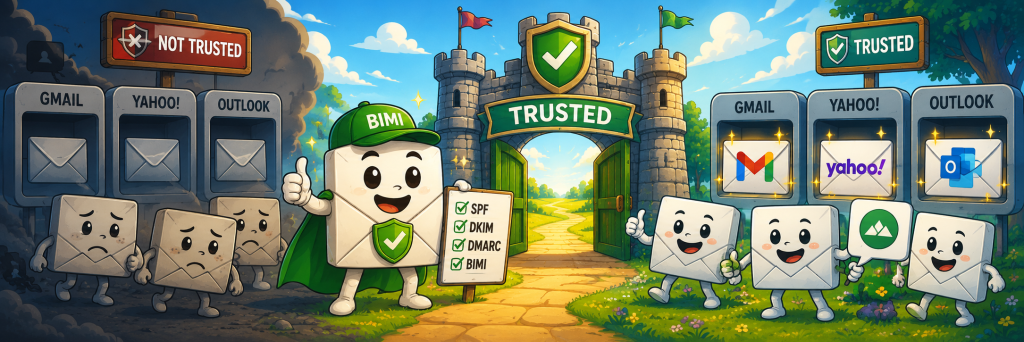
Most teams want BIMI because they want the logo. Mailbox providers read it differently: the logo is a visible privilege attached to authentication, enforced DMARC, reputation, and brand evidence. If those parts are weak, the mark stays hidden or inconsistent, no matter how urgently marketing wants it.
The useful question is not “how do we add the logo?” It is “has the email program earned the right to make the brand visible?” That shift changes the whole project. BIMI becomes a roadmap for sender maturity, not a decoration task.
Table of Contents
The logo comes after the trust work
A brand can be ready for visibility before its email program is ready to deserve it.
Picture a marketing team preparing a major launch. The creative is approved, the brand mark is polished, and leadership wants the logo next to every message in the inbox. Then operations asks the uncomfortable questions: is DMARC enforced, are every sending source and subdomain aligned, does the domain have a clean reputation history, and does the logo meet provider rules?
That is the moment BIMI becomes useful. It exposes the distance between brand aspiration and sender maturity. Brand Indicators for Message Identification lets domain owners publish a brand indicator that participating mailbox providers may display beside authenticated mail. But the visible result is conditional. The logo is the last thing the recipient sees, not the first thing the sender should configure.
That distinction protects teams from a common mistake: treating BIMI like a design task. A logo file and a DNS record matter, but they sit at the end of a longer chain. If authentication is inconsistent or reputation is weak, the inbox will not treat the logo as a trust signal. It may not show it at all.
The roadmap is therefore sequential: prove identity, enforce policy, earn reputation, prepare brand evidence, and only then expect visual recognition. Skip the order, and the project becomes expensive theater.
Authentication gives providers a sender they can evaluate
Mailbox providers do not display a logo because a sender asks nicely. They first need to know which domain is responsible for the message.
That starts with the authentication stack: SPF, DKIM, and DMARC. SPF authorizes sending infrastructure. DKIM signs the message. DMARC connects those signals to the visible From domain and tells receiving systems what to do when alignment fails. If that foundation is loose, BIMI has nothing trustworthy to stand on.
A common failure is organizational, not technical. Marketing sends through one ESP, product notifications through another, support through a help desk platform, and finance through a billing system. Each stream may look legitimate internally, but providers see different identities unless the domain owner has governed them. The result is a brand that wants one visible logo while its mail behaves like several disconnected senders.
This is why authentication work should begin with an inventory, not with the BIMI record. Teams that need a narrower SPF path can use a practical reference like SafetyMails’ Gmail SPF checker workflow, while teams trying to understand domain-level sender risk should connect that work to sender governance. The goal is the same: make every legitimate sender accountable before asking providers to display the brand.
DMARC enforcement changes the conversation
Observation is useful. Enforcement is what changes provider confidence.
A domain sitting at p=none may be learning from DMARC reports, but it is not yet telling receivers to quarantine or reject unauthenticated mail. For logo display, that matters. Google’s official BIMI setup guidance says the DMARC policy must be set to quarantine or reject, and the pct value must apply the policy to 100 percent of outgoing mail. The IETF BIMI draft follows the same logic: the visual indicator depends on authenticated mail and enforceable domain policy.
Moving too fast is dangerous, though. A team that jumps straight to strict enforcement before mapping every sender can break legitimate transactional, support, or billing messages. That is why a DMARC checker result should trigger sender mapping and alignment review, not only a DNS edit.
The practical rule is simple: use p=none to learn, but do not confuse learning with readiness. The logo belongs after enforcement is stable enough that the organization can defend its own sending identity.
Reputation decides whether the signal is worth showing
Correct records prove structure. They do not prove behavior.
Two domains can publish similar authentication and logo records while producing very different provider reactions. One sends to permissioned, engaged recipients with low complaints and stable volume. The other sends sudden campaigns to stale or purchased lists. Mailbox providers will not treat those senders as equal simply because the DNS looks similar.
Yahoo’s Sender Hub makes this explicit: a logo may display when a record points to a valid SVG, DMARC quarantine or reject is in place, the message is bulk mail, and the sender has sufficient reputation and engagement. That last clause is the part many teams underweight. The logo standard does not replace sender reputation. It depends on it.
Reputation is built through behavior: clean acquisition, low hard bounces, low spam complaints, stable volume, predictable cadence, and recipients who recognize the sender. SafetyMails’ guide on how to check and improve sender reputation is the better starting point when those signals are weak. If the history looks risky, the logo should wait.
Providers do not reward branding that hides bad sending. They reward programs whose visible identity already matches responsible behavior.
The brand mark needs evidence of its own
Even a trusted sender can fail the logo step.
The brand team may have a beautiful mark in the design system, but mailbox providers need a constrained technical asset and, depending on the provider, proof that the organization has the right to use it. A decorative file copied from a website is not automatically a valid asset.
The assertion record usually points to a hosted SVG logo and may also point to evidence such as a Verified Mark Certificate or Common Mark Certificate. Google’s guidance requires a VMC or CMC for the domain and logo, HTTPS hosting for logo files, and an eligible SVG format. The IETF draft treats the published indicator as a DNS-based policy object, not as an image dropped into a campaign template.
That creates a cross-functional project. Marketing owns the brand mark. Legal may need to confirm trademark or prior-use evidence. DNS administrators publish and maintain the record. Email operations validates authentication and provider behavior. If any one of those groups treats the rollout as somebody else’s task, the result becomes fragile.
A useful readiness pass separates sender prerequisites from brand-asset prerequisites:
- Authentication and alignment are stable across legitimate senders.
- DMARC is enforced with
p=quarantineorp=rejectat full effect. - The SVG logo is hosted over HTTPS and meets provider constraints.
- Certificate evidence is available where the target provider requires it.
- Ownership exists for monitoring, renewals, and provider-specific troubleshooting.
This list is not bureaucracy. It prevents a public brand project from being blocked by a private governance gap.
Certificates prove rights, not sending quality
A certificate can prove the mark. It cannot clean the sender.
Verified Mark Certificates and Common Mark Certificates exist to support evidence around the brand indicator. The current IETF draft defines VMCs for registered trademarks or government marks, while CMCs support prior-use marks or modifications of registered trademarks. Google also distinguishes VMC and CMC eligibility in its guidance.
That evidence matters, especially for brands at risk of impersonation. But buying or issuing certificate evidence does not lower complaints, fix bounces, repair DMARC alignment, or make old subscribers recognize the sender again. A company with weak engagement can obtain brand evidence and still fail to earn consistent display.
Use certificates for what they are: proof around the mark. Treat sender quality as a separate discipline.
Provider support changes what recipients see
One logo setup does not create one universal inbox experience.
A sender may see the logo in one mailbox and nothing in another. That does not always mean the record is broken. Provider support, user interface choices, certificate expectations, reputation signals, device type, and rollout behavior all influence what recipients actually see.
This matters for internal expectations. A marketing lead may test a Gmail account and assume the project is finished. A customer success manager may check a corporate mailbox and see no logo. Both observations can be true. Logo display is provider-mediated visibility, not a sender-controlled guarantee.
The right implementation plan starts with the audience mix. If a list is heavily Gmail and Yahoo, provider-specific requirements deserve priority. If the list is mostly corporate domains and desktop clients, the business case should be more cautious. The logo can still reinforce recognition, but the visible payoff may be uneven.
Gmail and Yahoo do not ask the same question
Gmail leans heavily on certificate-backed brand evidence. Yahoo foregrounds reputation and engagement.
For Gmail-heavy audiences, the team should plan around VMC or CMC requirements, eligible SVG files, HTTPS hosting, and DMARC enforcement. Google also notes that Gmail can show a checkmark next to senders verified with a VMC. That is a stronger visual treatment, but it raises the bar for brand evidence.
Yahoo’s published criteria are different. Yahoo does not currently require VMCs for logos to appear in its applications, but it does require a valid record, a valid SVG, DMARC quarantine or reject, bulk-mail context, and sufficient sender reputation and engagement. In other words, Yahoo is explicit that behavior still decides whether the signal deserves display.
The strategic move is not to chase every provider equally. Prioritize the providers your recipients actually use, then align certificate, reputation, and asset work to that reality.
Readiness starts before the BIMI record
The record is easy to publish compared with the discipline it represents.
A team is ready for the logo when its sending program can survive scrutiny without it. That means every legitimate platform is authenticated, DMARC enforcement is intentional, the domain reputation is healthy, recipients recognize the sender, and list quality is controlled enough that reputation signals remain readable.
SafetyMails fits the broader workflow at the audience layer. The logo is not solved by list verification, but sender reputation is easier to protect when invalid, stale, disposable, and risky records are not distorting engagement and bounce patterns. A serious email verification service helps keep that layer cleaner while authentication and policy teams strengthen the identity layer.
The human layer matters too. If recipients do not remember opting in, if the sender name is inconsistent, or if the message feels unexpected, the logo cannot create trust by itself. SafetyMails’ piece on permission based email marketing is a useful companion here because the mark amplifies recognition only when recognition already exists.
Use the record as the final coordination point, not the starting gun. When the hidden work is already stable, the DNS step becomes a controlled release rather than a bet.
Use the logo to reinforce trust, not repair it
A visible brand mark can make trust easier to recognize. It cannot manufacture trust from weak sending.
That is the strongest editorial frame for the standard. The logo helps recipients identify a legitimate brand in a crowded inbox. It can support recognition before the open. It can reduce confusion when phishing risk is real. But it does not act like a deliverability switch, and it should never become a substitute for authentication, reputation, permission, or clean data.
A disciplined team uses the logo after the foundations are already visible in the metrics: stable authentication pass rates, low complaints, controlled bounces, healthy engagement, and consistent sender identity. If those signals are weak, the next project is not the logo. The next project is the sender program.
For a wider view of that operating model, connect this project to the broader discipline of email deliverability. The logo sits inside that system as a recognition layer. It does not replace the system.
Conclusion
BIMI shows your logo when mailbox providers can trust the work behind it. The path is not complicated, but it is sequential: authenticate every legitimate sender, enforce DMARC, protect sender reputation, prepare eligible brand evidence, and set provider-specific expectations before announcing the visual win.
The logo is a reward for a disciplined email program. Treat it that way, and the standard becomes more than a brand flourish. It becomes proof that the invisible parts of sender trust are finally organized enough to be seen.
FAQ
What is BIMI?
BIMI stands for Brand Indicators for Message Identification. It is a standard that lets domain owners publish a brand indicator, usually a logo, that participating mailbox providers may show beside authenticated messages when the sender meets trust and provider requirements.
Does BIMI improve email deliverability?
BIMI does not guarantee inbox placement or directly fix email deliverability. It can reinforce recognition for trusted senders, but delivery and inbox placement still depend on authentication, DMARC enforcement, reputation, list quality, engagement, and provider filtering.
Do you need DMARC before BIMI?
Yes. BIMI depends on authenticated, DMARC-aligned mail. Major provider guidance expects DMARC to move beyond p=none, typically to p=quarantine or p=reject with full policy application, before the logo can be treated as a credible signal.
Why is my BIMI logo not showing?
A BIMI logo may not show because DMARC is not enforced, SPF or DKIM alignment is incomplete, sender reputation is too weak, the SVG logo or HTTPS hosting is invalid, certificate evidence is missing where required, or the recipient’s provider or client does not display BIMI in that context.